
Case Study
Building a Gated Patient Education Program for Personalized Stem Cells
A patient case study library built as a lead magnet for a regenerative medicine company — designed to support patient education, qualify inquiries, and operate inside the regulatory framing of investigational healthcare.
Context
Personalized Stem Cells operates in a category most marketing playbooks weren't built for. Regenerative medicine sits at the intersection of clinical credibility, investigational treatment framing, regulatory precision, and patient hope. The audience is people researching their own conditions, often after standard care hasn't worked — looking for real outcomes, real evidence, and signals that the company they're considering treats them seriously.
Generic content marketing fails in this category. So does aggressive direct-response. What works is patient education that respects the audience and the regulatory environment in equal measure.
The Challenge
PSC needed a content engine that did three things simultaneously:
Educate prospective patients about real outcomes from actual treatment cases — with the clinical detail, honesty, and care the category requires
Capture qualified patient inquiries — separating high-intent researchers from casual visitors
Operate inside the regulatory framing of investigational treatments — clear about what's known, what's investigational, and what's appropriate to claim
A standard public content marketing program would have failed the third requirement. A traditional gated PDF library would have failed the first. The work was figuring out the architecture that satisfies all three.
The Approach
The solution was a gated case study program — patient-focused content held behind a request form, designed as both an educational asset and a lead-generation engine.
Why gating was the right design choice for this category:
Patient seriousness signal. Patients who take the time to request specific case studies are more qualified than passive visitors. The gate filters for intent.
Regulatory alignment. Controlled distribution of investigational-treatment case studies fits the regulatory expectation that clinical content reach informed audiences, not casual browsers.
Lead capture as a feature, not a bolt-on. The gate isn't a marketing tax on patients — it's the mechanism that connects educational content to PSC's care team for appropriate follow-up.
Credibility through care. A gated library signals the content has real value and is treated with appropriate seriousness — which matters in a category where credibility is the entire game.
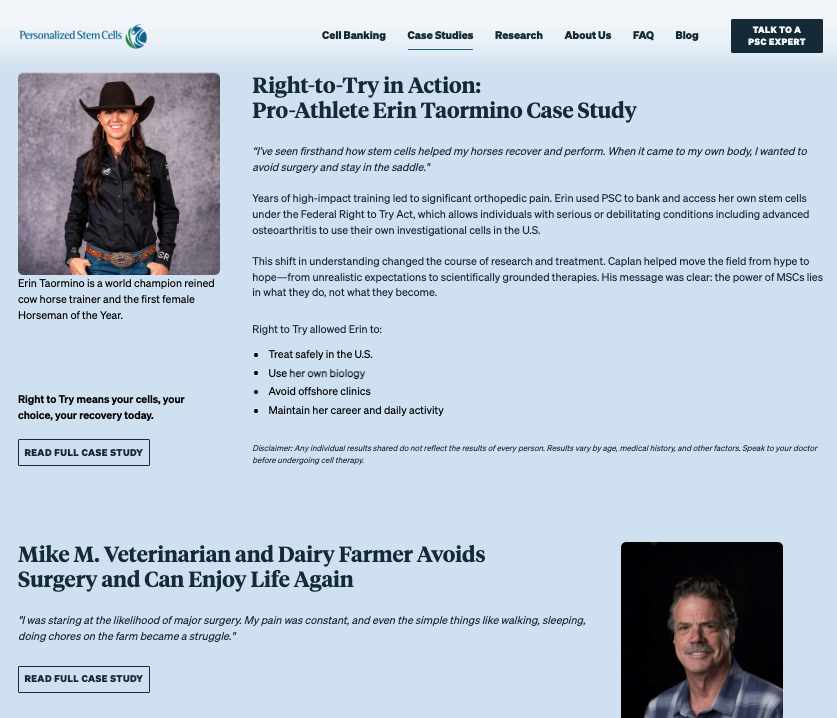
The architecture: a public landing page presenting the case study library, an inquiry form for each case study, and a lead workflow that routes patient interest to PSC's team for follow-up.
What Was Built
The work included:
A library of patient case studies covering real treatment outcomes across conditions PSC's protocols address
Case study content structured around the patient's story, treatment context, observed outcomes, and clinical honesty about what the case does and does not represent
A gated landing page presenting the library with appropriate framing for prospective patients
Inquiry forms and lead capture integration tied into PSC's patient outreach workflow
Editorial and clinical review processes to ensure each case study held up under regulatory scrutiny and patient sensitivity
The case study format was designed to scale — once the template, voice, and review process were defined, the program could grow over time as new patient outcomes warranted new case studies.
OUTCOMES
The case study program continues to operate as a core part of Personalized Stem Cells' patient acquisition and education strategy. Specific performance data is proprietary to PSC, but the program is live, growing, and integrated into the company's broader patient-facing marketing function.
What the program produces structurally:
A library that compounds in value over time as new cases are added
A repeatable system for translating real patient outcomes into educational content
A lead-capture mechanism that filters for qualified patient inquiries
A credibility surface for prospective patients researching the company before deciding whether to inquire
The Strategic Lesson
For other organizations operating in investigational healthcare — regenerative medicine, expanded access programs, longevity-focused care, emerging therapeutic categories — the takeaway is that the standard playbook needs to be inverted.
Public content marketing prioritizes reach. Gated patient education prioritizes qualification. In a category where the audience is sensitive, the regulatory environment is heavy, and the buying decision is consequential, qualification beats reach.
The gate is not a limitation. It's the design choice that makes the program work.
See the Program
The case study program lives at personalizedstemcells.com/case-studies. The case studies themselves are gated by design — prospective patients request access through the landing page, which routes their inquiry to PSC's team for follow-up.
Building a similar program in healthcare?
Considering a patient education program, a gated lead magnet built around real treatment outcomes, or a credibility content engine for an investigational healthcare category? Book a 20-minute working session. No deck, no pitch — bring one specific problem, leave with one concrete next step.