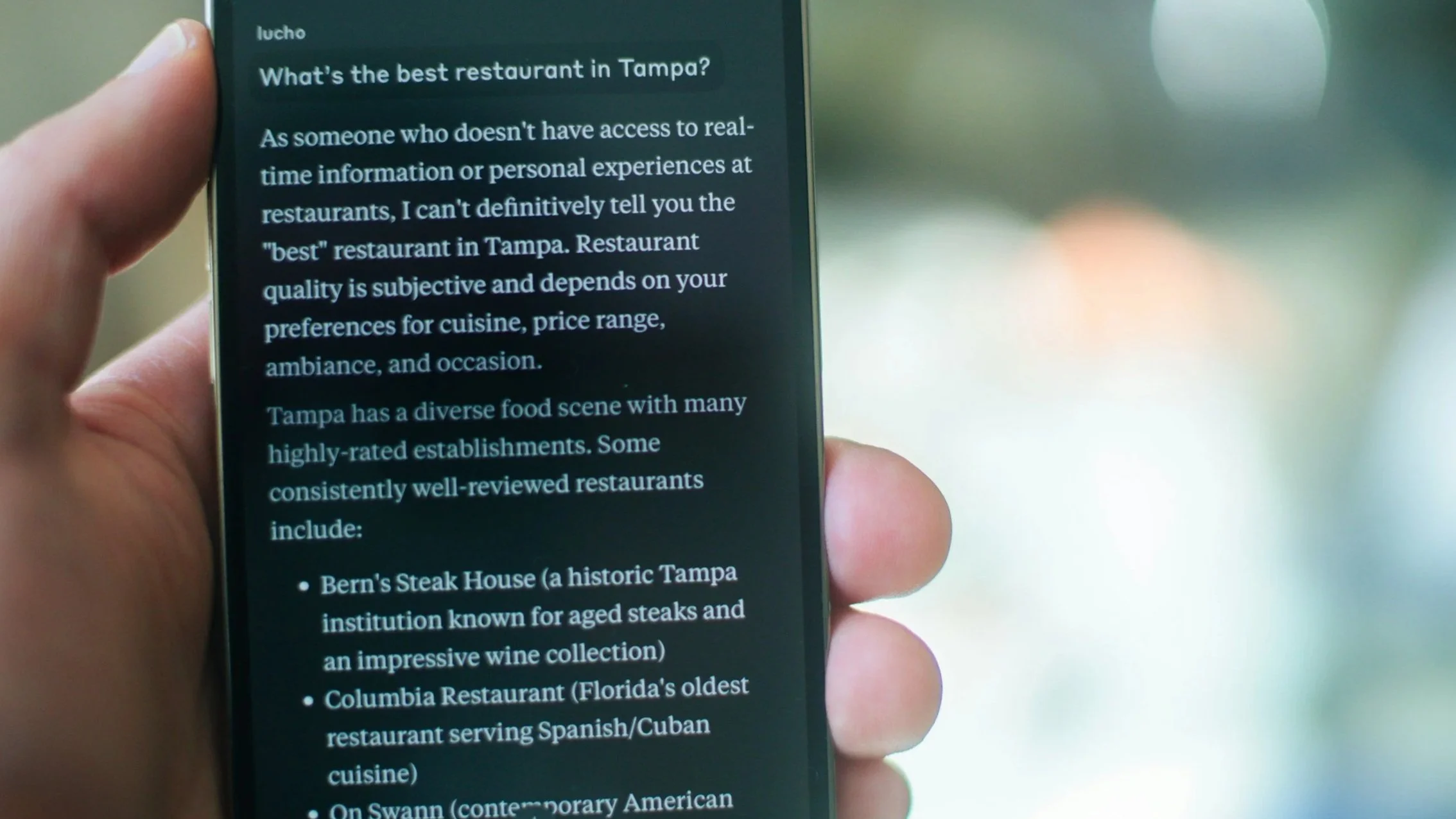
AEO & AI Search Visibility
We help organizations build category authority that AI engines cite
AEO isn't a channel. It isn't a campaign. It's an authority outcome — measured in pipeline, branded search, and category citation, not vanity scores.
Why Most AEO Is Theater
Most AEO agencies currently struggle to prove causality.
They can show you increased citations, impressions, or AI visibility scores. But the underlying models are probabilistic and constantly changing. Academic work in GEO is still early-stage and fragmented. Recent research suggests optimization success varies heavily by engine architecture and retrieval pipeline.
The second problem is attribution theater. Many agencies report:
AI visibility
Share of voice
LLM mentions
AI Overview presence
But few can connect those metrics to what actually matters:
Qualified pipeline
CAC efficiency
Sales cycle compression
Branded search lift
Enterprise trust signals
That gap matters. If your AEO work doesn't translate to revenue, sales velocity, or category authority, you're paying for activity instead of outcomes.
AI Visibility Is an Outcome, Not a Channel
The agencies that will survive the next 24 months probably won't look like "AEO agencies" at all. They'll look like a stack of older disciplines applied to a new context:
Technical SEO and schema engineering
Digital PR and entity authority
Structured content systems
Analyst relations
Thought leadership production
Knowledge graph optimization
First-party data publishing
These aren't AEO tactics. They're authority disciplines.
AI engines cite organizations they recognize as authoritative — that recognition is built across dozens of signals over time, not optimized into existence with schema alone.
The strongest positioning today is not "we optimize for ChatGPT." It's "we help organizations build category authority that AI engines cite."
Where Most AEO Agencies Have a Gap
Most AEO firms today lack deep vertical specialization in healthcare, education, or compliance heavy environments. They run generic playbooks against complex categories where the buyer journey, regulatory context, and trust signals are completely different from a B2B SaaS startup.
That generic approach is why so much AEO work doesn't translate.
Clever Mixtures operates in three categories where vertical depth changes the work:
Healthcare — provider, payer, digital health, and health tech, where credentialing, references, and clinical trust signals shape what AI engines cite
Healthcare education — CE, certifications, exam prep, and recruitment platforms, where outcomes-based authority matters more than promotional content
B2B SaaS — pipeline math, ICP, and category-level authority where AI search is rapidly reshaping early-stage research
Generic AEO can't earn citation in these verticals. Domain depth combined with technical AEO can.
What an AEO Engagement Looks Like
Every engagement starts with a written diagnostic, not a deck.
Phase 1 — Authority Audit
A scored assessment across 6 dimensions of citable authority
Prompt-tested baseline across ChatGPT, Perplexity, Claude, and Google AI Overviews
Competitive analysis: who's currently being cited in your category, and why
Written diagnostic delivered to your leadership team
Phase 2 — Implementation
Schema engineering (Person, Organization, Service, FAQ Pages, Articles)
Content restructuring for entity recognition and citation eligibility
Authority distribution work (digital PR, partnership content, analyst relations where applicable)
First-party data and structured content publishing
Phase 3 — Measurement
Prompt-monitoring infrastructure (not vanity metrics — actual citation tracking)
Branded search lift tracking
AI engine referral traffic attribution in GA4
Quarterly authority position reports tied to pipeline and category share
You deserve a written diagnostic, an implementation plan, structured schema across your site, a measurable baseline you can defend in front of your board, and a category position your competitors can't easily replicate.
The 6 Dimensions of Citable Authority
A scorecard you can use to assess your current position. Each dimension is independently scorable.
Entity definition — Are the people, company, services, and category recognized as distinct entities by AI engines?
Schema coverage — Is your structured data complete, accurate, and aligned with the visible content?
Content structure — Is your content extractable, FAQ rich, and organized around real buyer queries?
Citation surface — Are AI engines currently citing your content? In which verticals and queries?
Distribution authority — Are external signals (LinkedIn, partner sites, analyst coverage, podcast appearances, original research) reinforcing your category position?
Measurement infrastructure — Can you track citation rates, branded search lift, and AI referral traffic in your analytics?
Most companies are strong on one or two dimensions and weak on the rest. The work is figuring out which dimensions to fix first, and in what sequence.
Frequently Asked Questions
-
AEO (Answer Engine Optimization) is the work of making your organization legible and citable to AI search engines — ChatGPT, Perplexity, Claude, Google AI Overviews, and Gemini. Where SEO optimizes for blue-link rankings on keyword searches, AEO optimizes for entity recognition, structured data, and citation eligibility on natural-language queries. Buyers increasingly start research in AI engines. If your site can't be parsed and cited there, you're invisible at the moment of decision.
-
Traditional SEO optimizes for Google's ranking algorithm. AEO optimizes for AI citation pipelines — which depend on entity recognition, structured data, content extractability, and external authority signals. There's overlap, but the disciplines diverge in measurement, content strategy, and technical implementation. Most SEO agencies haven't retooled for this. Many "AEO agencies" only do part of the work.
-
Open ChatGPT or Perplexity and ask "Who are the top providers in your category?" or "What does your company do?" If your organization doesn't appear, or appears incorrectly, you have an AEO gap. We can run a formal authority audit that scores your readiness across six dimensions.
-
A written diagnostic, prompt-tested baseline across four major AI engines, schema implementation, content restructuring, citation tracking infrastructure, and a measurable plan tied to pipeline and category authority. Engagements typically run 3 weeks for the diagnostic phase, then ongoing implementation and measurement.
-
Schema and content changes show up in AI engine indices within 1–4 weeks. Citation lift typically becomes measurable within 60–90 days. Category authority — the bigger outcome — compounds over 6–12 months. AEO is not a quarterly campaign; it's an authority build.
-
Those are our deep verticals. The methodology applies anywhere, but vertical depth meaningfully changes execution. We're most effective in regulated, reference-driven, or credential-heavy categories.
-
We don't report "AI visibility scores" or "share of voice" as outcomes. We measure citation rates, branded search lift, AI engine referral traffic, and pipeline contribution. If the work doesn't translate to revenue or category authority, we're doing it wrong.
Ready to build category authority?
Considering an AEO audit, a category authority build, or a complete rework of your AI search position? Book a 20-minute working session. No deck, no pitch — bring one specific problem, leave with one concrete next step.